

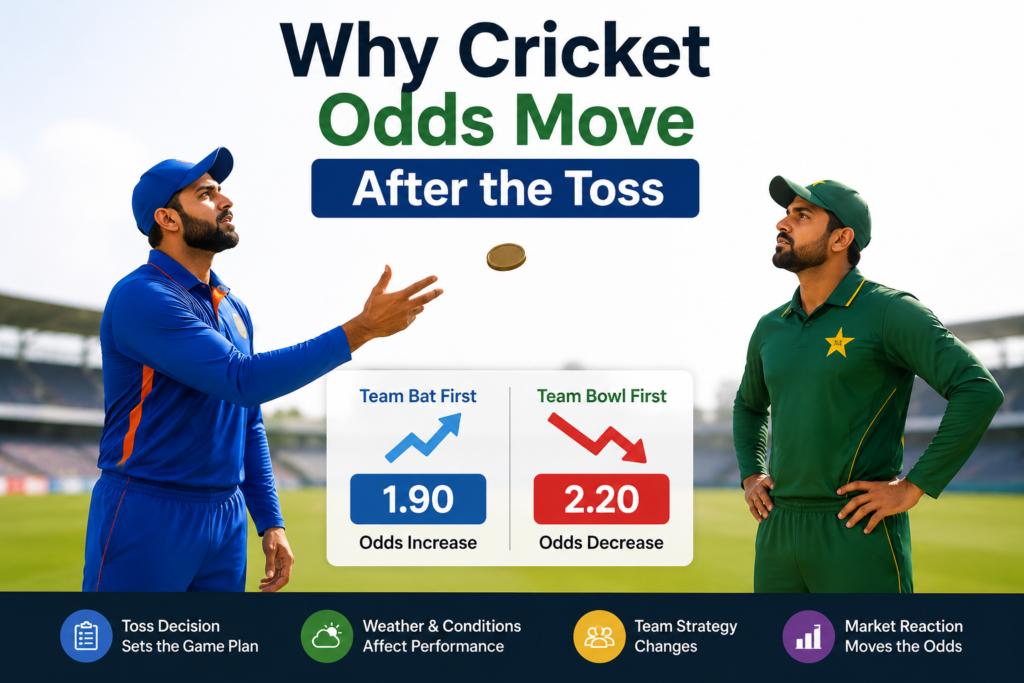
Why Cricket Odds Move After the Toss
Cricket matches can look completely different once the toss takes place. A team that appeared evenly matched before the game may suddenly become the market favorite after the captain announces a decision to bat or bowl first. For followers using platforms such as tigerexch, understanding this movement provides useful context for why prices can change within minutes of the toss.
The toss itself does not change a team’s players or previous performances. What changes is the information available to the market. The decision made by the captain can reveal how the team views the pitch, weather, dew, and expected conditions later in the match. The confirmed playing XI can also remove uncertainty surrounding injuries, player availability, and tactical combinations.
This is why the period immediately after the toss is often one of the most active points before a cricket match begins. The market absorbs new information and adjusts its expectations accordingly.
Why tigerexch Markets React After the Toss
Before the toss, several important details may still be unknown. Teams may not have confirmed their final XI. The captain has not yet revealed whether the side prefers to bat first or chase. Weather conditions may also be developing, while the pitch assessment can change once players and officials inspect it closely.
After the toss, many of these uncertainties disappear. Suppose a team wins the toss and chooses to bat because its captain believes the pitch will become slower later in the evening. That decision gives observers an additional piece of information about expected playing conditions.
If the opposing captain chooses to bowl first because they expect dew to make batting easier later, the market may interpret that decision differently. The result is a reassessment of the expected match scenario.
How the Toss Changes Match Information
The toss provides more than a simple decision between batting and bowling. It can reveal a team’s tactical preference. Captains consider several variables before making their decision, including pitch behavior, weather forecasts, ground dimensions, recent results at the venue, and the strengths of their own squad.
A decision to bat first may suggest confidence in setting a target. A decision to bowl first may indicate that the team expects conditions to improve for batting later. Neither approach is automatically correct. The importance of the decision depends heavily on the venue and format.
The Impact of Pitch Conditions
Pitch behavior is one of the biggest reasons prices can change after the toss. Some surfaces are excellent for batting early but become slower as a match progresses. Others may offer movement to fast bowlers with the new ball before becoming easier to bat on.
Spin can also become more influential on certain pitches as the innings develops. A captain who has inspected the surface may have information that was difficult for outside observers to assess before the match.
This can influence expectations about scoring rates, wicket-taking opportunities, and the relative strengths of each team.
Dew and Night Matches
Dew can have a major influence on evening cricket, particularly in certain venues and conditions. When moisture develops on the outfield and ball, fielding can become more difficult. A wet ball may also be harder for bowlers to grip, potentially affecting the effectiveness of spin and certain variations.
This is one reason teams sometimes prefer chasing under lights. However, dew is not guaranteed in every match. Temperature, humidity, wind, ground conditions, and local weather patterns all influence whether it becomes significant.
Market participants therefore consider the expected conditions rather than treating dew as an automatic advantage.
Team Selection Becomes Clearer
Another major source of movement is the confirmed playing XI. Before the toss, there can be uncertainty over which players will take part. Once teams announce their lineups, that uncertainty disappears.
The absence of a leading batter, specialist bowler, or key all-rounder can change expectations significantly. Likewise, selecting an additional spinner or strengthening the batting lineup can affect how a team is expected to approach the match.
This is particularly important in short-format cricket, where one specialist player can have a substantial influence over a limited number of overs.
How tigerexch World Followers Can Interpret Post-Toss Movement
The most useful way to understand a post-toss price change is to ask what new information became available.
Rather than focusing only on the direction of movement, consider the underlying reason.
- Was a key player ruled out?
- Did the winning captain choose to chase?
- Is there a strong historical chasing advantage at the venue?
- Are weather conditions expected to change?
- Does the pitch appear better suited to batting first?
These questions provide context. A market movement is an expression of changing expectations. It is not proof that one team will eventually win.
Batting First vs Chasing
The decision to bat or bowl first can have a different significance depending on the format. In T20 cricket, teams may prioritize maximizing the powerplay and building a strong total before attacking during the final overs. In ODI cricket, innings management becomes more complex because teams have substantially more overs to build a score.
In Test cricket, the toss can have an even broader strategic impact because pitch deterioration, session conditions, and the length of the match become important factors. As a result, the same toss decision cannot be interpreted in exactly the same way across every format.
Venue History Can Influence Expectations
Ground-specific statistics can provide useful context. Some venues have historically produced high-scoring matches, while others have favored bowlers.
Factors worth examining include:
- Average first-innings score
- Chasing success
- Boundary dimensions
- Pace-bowling effectiveness
- Spin performance
- Typical weather conditions
- Dew patterns during evening matches
Historical data should not be treated as a guarantee of future performance. Conditions and team quality change from match to match. However, venue history can help explain why a toss decision may be viewed as more significant at one ground than another.
Why Live Conditions Matter After the Toss
The information available after the toss does not remain static. Once the match begins, real events provide even more evidence. The first few overs can reveal whether the pitch is offering movement, whether batters are comfortable, and how quickly the ball is traveling.
A team that looked strong on paper may struggle if conditions are unexpectedly difficult. Conversely, a side expected to face challenging conditions may score freely if the pitch proves easier than anticipated. This is why match analysis should consider actual performance rather than relying entirely on pre-match expectations.
How Weather Can Influence the Market
Weather is another important factor surrounding toss-related movement. Rain can reduce the number of overs available, potentially changing the tactical structure of a match. A shortened T20 contest, for example, may place greater emphasis on power hitting because there is less time to recover from a slow start.
Wind can also influence bowling and shot selection. Cloud cover may affect how fast bowlers approach the opening overs in certain conditions. These variables help explain why weather information becomes more valuable once the toss and starting conditions are confirmed.
Why the Toss Does Not Guarantee an Advantage
Winning the toss can provide a strategic opportunity, but it does not determine the result. A captain can make what appears to be a sensible decision and still lose because the opposition performs better.
A team may choose to chase because of expected dew but struggle to control the required run rate. Another side may bat first expecting favorable conditions but lose early wickets.
Cricket contains too many variables for one decision to guarantee success. The toss should therefore be viewed as one factor within a much larger match picture.
Reading Odds Without Overreacting
Rapid changes immediately after the toss can attract attention, but movement should always be considered alongside the reason behind it. A significant price adjustment may reflect new information rather than a prediction that one team is certain to win.
It is also important to distinguish between market movement and actual probability. Even when a team becomes the favored side, there remains uncertainty because sporting outcomes cannot be guaranteed.
A more informed approach is to understand what changed, why it changed, and whether the new information genuinely affects the match scenario.
The Role of Data in Modern Cricket Analysis
Cricket analysis has become increasingly data-driven. Teams and analysts now examine player matchups, venue records, scoring patterns, bowling lengths, strike rates, expected scoring rates, and historical performance under specific conditions.
The toss adds another layer to this information. Modern match analysis can combine the decision at the toss with historical venue data, confirmed lineups, weather information, and tactical preferences.
For fans, this makes the period between the toss and first ball particularly interesting because several previously uncertain variables become available at once.
A Simple Framework for Understanding Post-Toss Changes
When prices change after the toss, consider five questions:
- What was unknown before the toss?
- What information has now been confirmed?
- How does the pitch affect each team?
- Does batting first or chasing suit the conditions?
- Has the playing XI changed the team’s balance?
Answering these questions provides a much stronger analytical foundation than simply observing that a price has moved. It also encourages readers to understand cricket through context rather than relying on isolated statistics.
Conclusion
Cricket odds can move significantly after the toss because the market suddenly receives information that was unavailable beforehand. The decision to bat or bowl, confirmed playing XIs, pitch assessments, weather conditions, dew expectations, and venue characteristics can all influence how a match is viewed.
For followers of tigerexch, understanding these factors makes post-toss movement easier to interpret. The key is to look beyond the number itself and consider what new information caused expectations to change.
The toss can create a tactical advantage, but it does not determine the winner. Cricket remains dependent on execution, partnerships, wickets, bowling spells, conditions, and countless moments that unfold after the first delivery.
Ultimately, the most useful approach is to treat post-toss market movement as information about changing expectations rather than a guaranteed prediction of the final result.
Frequently Asked Questions
Why do cricket odds change after the toss?
Odds can change because the toss reveals whether a team will bat or bowl first, while confirmed lineups, pitch assessments, weather expectations, and tactical decisions provide additional information.
Does winning the toss give a team an advantage?
It can provide a strategic advantage depending on the pitch, weather, venue, and match format, but winning the toss does not guarantee victory.
Why do teams choose to chase?
Teams may choose to chase when conditions are expected to become easier for batting later, particularly when dew could make bowling and fielding more difficult.
Does the pitch affect cricket odds after the toss?
Yes. Information about whether a pitch favors batting, pace, or spin can influence expectations about scoring and wicket-taking during the match.
Why does the playing XI affect post-toss prices?
The confirmed XI removes uncertainty about player availability and team balance. The absence or inclusion of an important batter, bowler, or all-rounder can change expectations.
Are post-toss odds more accurate than pre-toss odds?
Post-toss markets have access to more information, but that does not make them guaranteed or perfectly accurate. Cricket remains unpredictable, and new information continues to arrive after play begins.